

We’ve all been there: it’s 3:00 PM, your eyes are glazing over a spreadsheet, and your brain feels like it’s trapped in a thick fog. Your immediate instinct is probably to head to the breakroom for another cup of coffee or an energy drink. But while caffeine gives you a temporary spike in alertness, it often leaves you with the jitters, an afternoon crash, and a disrupted sleep cycle.
If you’re looking for natural ways to improve concentration, the most powerful tool might actually be your own breath.
Lately, somatic practices are proving to be a game-changer for cognitive performance.
Let’s look at the science of how breathwork for productivity works, and how you can use it to sharpen your mind without a drop of caffeine.
When you need an immediate hit of focus, your instinct is likely to reach for a cup of coffee or an energy drink. Caffeine is the world’s most popular cognitive enhancer, but it achieves alertness by borrowing energy from your body, whereas somatic practices like breathwork generate it.
Here is a breakdown of how caffeine interacts with your nervous system compared to a conscious breathing practice.
The Caffeine Mechanism: Unchecked Sympathetic Drive
Caffeine works primarily as an adenosine receptor antagonist. Adenosine is a chemical that builds up in your brain throughout the day, signalling to your body that it’s time to slow down and rest. Caffeine blocks these receptors, essentially masking your tiredness.
At the same time, caffeine stimulates the adrenal glands to release cortisol and adrenaline—the body’s primary stress hormones. This triggers a sudden shift into a sympathetic nervous system state (“fight-or-flight”). While this process successfully sharpens your immediate attention span, it does so by forcing your system into a state of survival-driven panic.
The consequences of this forced state are highly predictable:
- The Physical Cost: Accelerated heart rate, shallow chest breathing, muscle tension, and the infamous “caffeine jitters.”
- The Mental Tax: A narrow, hyper-reactive focus that makes it difficult to sit with complex, creative problem-solving.
- The Aftermath: Once the caffeine metabolizes, the blocked adenosine floods your receptors all at once, leading to a severe midday energy crash and subsequent sleep disruption.
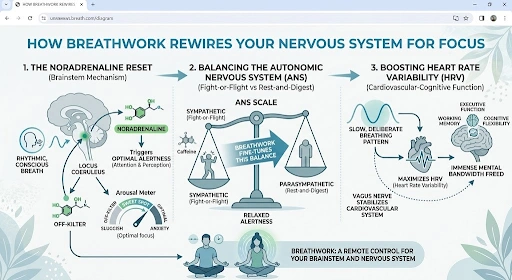
How Can Breathwork Improve Focus and Concentration Naturally?
Unlike caffeine, which forces an unchecked stress response, conscious breathing allows you to directly interface with your nervous system. Instead of overriding your body’s signals, specific breathing patterns change the physiological data sent from your lungs and heart up to your brainstem.
Targeted Chemistry: Optimizing Noradrenaline Release
Rather than flooding your system with adrenaline, rhythmic breathing stimulates the locus coeruleus to release an optimal, balanced amount of noradrenaline. This sharpens your attention span naturally without triggering anxiety.
Cultivating “Flow”: Balancing the Autonomic System
Breathwork balances the sympathetic branch with the parasympathetic (“rest-and-digest”) branch. This creates a state neurophysiologists call relaxed alertness—allowing you to think deeply, retain working memory, and stay calm under pressure.
Comparison: Caffeine vs. Breathwork for Productivity
| Feature | Caffeine | Breathwork |
| Nervous System State | Forced Sympathetic (Stress Response) | Balanced Autonomic (Relaxed Alertness) |
| Primary Chemical | Cortisol, Adrenaline, Blocked Adenosine | Regulated Noradrenaline |
| Cognitive Effect | High alertness, potential jitters/anxiety | High focus, calm clarity, “flow” state |
| After-Effects | Midday energy crash, sleep disruption | Sustainable energy, lower baseline stress |
Your focus isn’t something you have to buy, brew, or borrow—it is a physiological state you can consciously create. The next time the afternoon fog rolls in, skip the trip to the coffee machine. Step back, tune into your nervous system, and realize that your sharpest, most productive self is always just a few intentional breaths away.