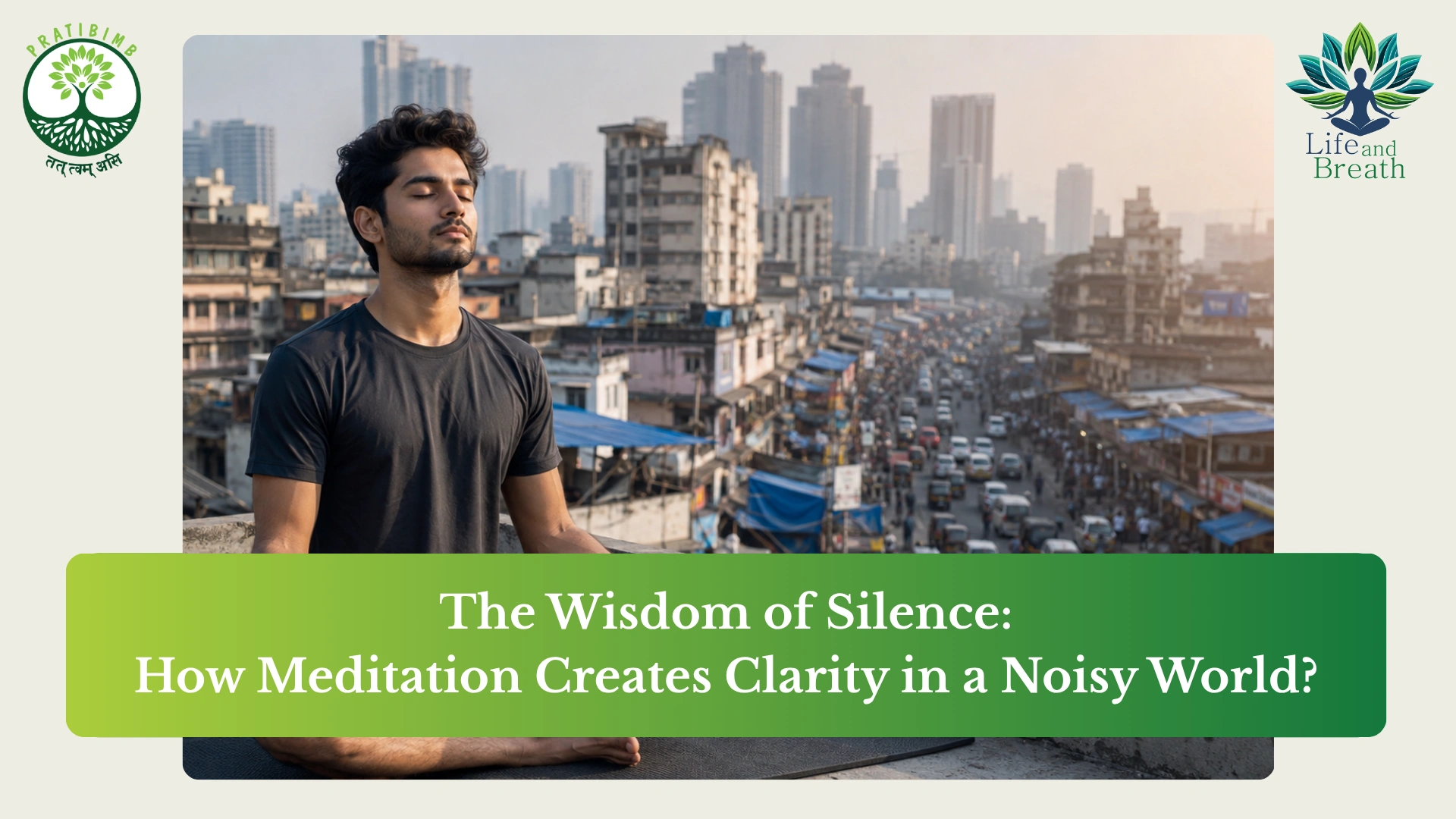
Meditation, for me, is the practice of observing what is happening within me without immediately reacting to every thought or emotion. Meditation for clarity is not about forcing the mind to become blank. It is about creating enough inner space to see the mind more clearly.
We live in a world where silence is becoming rare. Work, phones, social media, money, relationships, ambitions, and uncertainty constantly demand our attention. Whether we live in Mumbai, London, New York, or a small town, our surroundings may differ, but the mind keeps travelling. Sometimes the biggest noise is not around us. It is within us.
Why Did I Feel the Need for Meditation
I moved towards meditation because I wanted to understand why the mind continues to struggle even when there is no immediate problem in front of us.
I have always been ambitious. Professional growth, financial goals, investments, responsibilities, and the desire to keep learning have naturally kept my mind active.
Gradually, however, I noticed that solving one problem did not necessarily bring peace. The mind would soon find something else to think about.
- A workplace incident could remain in my mind long after I left work.
- A small concern could become much bigger in my imagination.
- My mind could create future situations that had not happened.
- Past experiences could affect how I looked at the present.
- After achieving one target, another target quickly appeared.
- My body could be resting while my mind was still working.
This made me curious. Perhaps the problem was not only what was happening in my life. Perhaps I also needed to understand the mind that was experiencing my life.
What changed when I started observing instead of reacting
The most practical lesson meditation has given me is simple: pause, observe, and respond.
Normally, something happens and we react. Someone criticises us, something goes wrong at work, or an investment moves against us. The mind immediately starts creating explanations, judgements, and responses.
Meditation has shown me that there can be a small space between what happens and what I do next. That space can help me respond with greater clarity instead of allowing a temporary emotion to decide for me.
What Has Silence Taught Me About My Mind
Silence has shown me that the mind keeps producing thoughts even when nothing is happening outside. Meditation helps me watch this process without participating in every thought.
Some thoughts are useful. Others are memories, fears, assumptions, or imagined situations that may never happen.
Through meditation, I have gradually understood that:
- Every thought does not require my response.
- Fear does not prove that something bad will happen.
- An emotion can be experienced without immediately acting on it.
- A memory can arise without requiring me to live through it again.
- A thought may pass if I do not continuously feed it.
- Silence can exist even when thoughts are still present.
This changed my understanding of meditation. I stopped expecting my mind to become completely blank.
Instead, I started trying to see my mind clearly.

Does meditation mean stopping all thoughts
No. In my experience, meditation is about noticing thoughts rather than forcibly stopping them.
A thought appears. Sometimes I notice it immediately, and sometimes I get carried away by it. When I realise that my attention has wandered, I gently return to my breath or body.
That return is not a failure. That return is part of meditation.
Why Are the Body and Breath Important for Staying Present
The mind can travel into the past or future, but the body always remains in the present. This makes body awareness and breath awareness natural anchors for meditation.
My mind can return to an incident from twenty years ago and recreate the emotions connected with it. A moment later, it can jump ten years into the future and begin worrying about situations that have not happened.
But my body cannot go with it.
- The mind can revisit the past.
- The mind can imagine the future.
- The body always remains in the present.
- Breathing is happening right now.
- Physical sensations connect me with what is happening now.
- Breath awareness helps bring a wandering mind back to the body.
We need the mind to learn from the past and plan for the future. The difficulty begins when we stop using those abilities and unknowingly start living inside them.
Why has breath awareness becomes meaningful to me
Breath awareness gives my wandering attention a simple and natural place to return.
My mind may be thinking about yesterday or worrying about tomorrow, but every inhalation and exhalation is taking place in this moment.
I do not need to force my breath or create a special experience. I can simply notice the sensations of breathing and allow the breath to follow its natural rhythm.
For me, the breath is like a bridge. It brings my attention back to my body, and my body brings me back to the present.
Does Meditation Help Me Understand Who I Am
Meditation has made me question whether every thought and emotion truly defines me. If I can observe a thought, perhaps I am more than that temporary thought.
During my inward journey, one simple reminder became meaningful to me: I am not only that.
When fear comes, I am not only that fear. When a negative thought appears, I am not that thought. When success or failure changes how I feel, I remain more than that temporary experience.
- Thoughts change.
- Emotions change.
- Circumstances change.
- Success and failure change.
- My understanding of myself changes.
- Yet something within me can observe all these changes.
I do not claim to have found a final answer about identity, consciousness, or the soul. I am still exploring.
Perhaps that honest exploration is also part of the inward journey.
Am I my thoughts or the one watching them
I may experience my thoughts, but I do not have to treat every thought as my complete identity or as an instruction I must follow.
This understanding gives me distance without requiring me to reject what I feel. I can recognise fear, anger, or uncertainty while remembering that each experience is temporary.
That distance gives me a choice: I can follow the thought, observe it, return to my breath, or decide that it does not deserve further energy.
How Does Meditation Support Mental Wellness
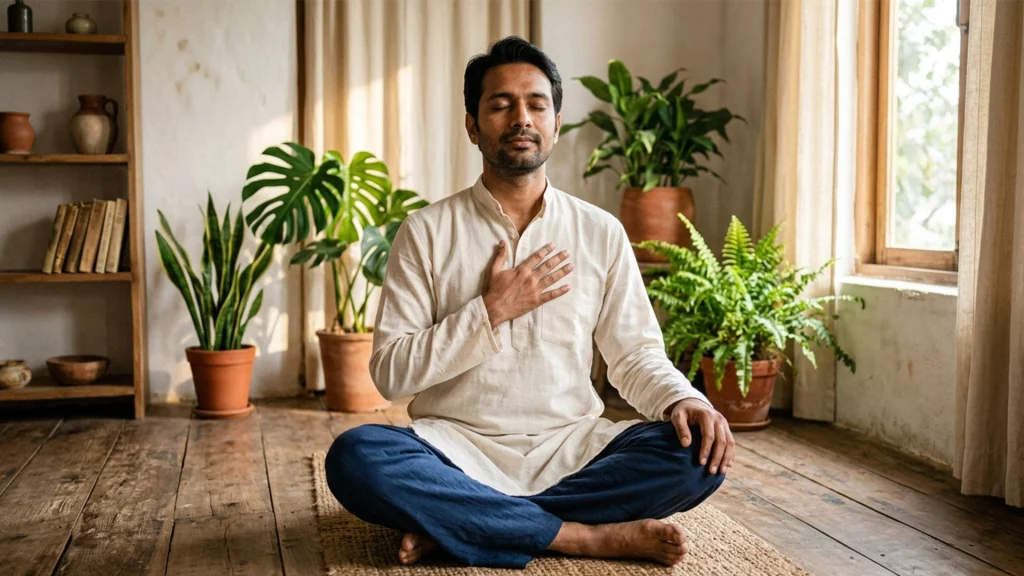
Meditation supports my mental wellness by helping me recognise thoughts, emotions, and reactions before they completely control my inner state.
For me, mental wellness does not mean remaining positive or peaceful all the time. Trying to feel positive every moment can itself become another form of pressure.
Meditation has helped me notice:
- When fear is creating an imaginary future.
- When my mind is unnecessarily repeating the past.
- When an emotion is affecting my judgement.
- When I should pause instead of responding immediately.
- When silence may be wiser than another argument.
- When a thought no longer deserves my energy.
My inner energy is limited. If I continuously spend it on fear, comparison, arguments, imagined situations, and things outside my control, very little remains for what genuinely matters.
Meditation does not solve every mental health difficulty, and it should not replace professional support when that support is needed. For me, it is a daily practice that helps me understand and use my inner energy more carefully.
Can meditation ever feel uncomfortable
Yes. Sitting quietly can sometimes make difficult thoughts, emotions, or memories more noticeable.
When that happens, I do not need to force myself to continue. I can open my eyes, feel my feet on the floor, observe my surroundings, or shorten the session.
Meditation should support mental wellness, not become another struggle. If it repeatedly causes serious distress, guidance from a qualified mental health professional may be more appropriate.
Can Guided Meditation Help Someone Begin
Yes. Guided meditation can provide structure when sitting silently with a restless mind initially feels difficult.
Different practices may help different people. There is no single method that everyone must follow.
- Guided meditation provides spoken instructions and direction.
- Breath awareness gives the mind a simple anchor.
- Body awareness reconnects attention with the present.
- Pranayama can increase awareness of breathing patterns.
- Silent meditation creates space for direct observation.
- Regular practice reveals recurring mental habits.
A beginner may find a five-minute guided meditation helpful, while someone with more experience may prefer silence. Neither approach is automatically better.
The most useful practice is one that feels natural, safe, and sustainable.
Do we always need someone to guide us
No. A guide can introduce the practice, but meditation eventually becomes a personal journey.
A teacher or recording can show me a direction, but nobody else can observe my fears, understand my reactions, or experience my silence for me.
Guidance can take me towards the door. The inward step must eventually become my own.
Can We Find Silence While Living in a Noisy World
Yes. Inner silence does not require the world around us to become completely quiet. It begins when we stop allowing every sound, thought, and event to control our attention.
This is not limited to one country, religion, or lifestyle. Someone may live in Delhi, Mumbai, London, or New York. Another person may spend time in the Himalayas, at a yoga centre in Rishikesh, or near a Zen temple in Kyoto.
Sooner or later, most of us return to everyday life:
- Offices, shops, and factories.
- Cities, traffic, and public transport.
- Phones, news, and social media.
- Financial responsibilities.
- Relationships and expectations.
- Deadlines and uncertainty.
A peaceful place can make it easier to turn inward, but peaceful surroundings cannot guarantee a peaceful mind.
Perhaps the purpose of silence is not to isolate ourselves permanently from noise. Perhaps it is to stand in the middle of noise without allowing every noise to enter us.
What is the real test of meditation
For me, the real test of meditation begins after I open my eyes.
Can I observe myself during a disagreement? Can I remain aware when work pressure increases? Can I pause when someone says something unpleasant?
Can I recognise fear before it creates an entire imaginary future?
Meditation becomes part of life when awareness enters ordinary moments. Its purpose is not only to help me sit peacefully in silence, but also to help me act with greater clarity when life is not peaceful.
What Is the Biggest Lesson Meditation Has Given Me
My biggest lesson is that not everything happening inside my mind is necessarily me, and not every thought deserves my attention or energy.
My journey is still continuing. I still become disturbed. I still react sometimes. I still worry and think about my future.
Meditation has not made me completely peaceful, but it has changed the way I relate to my mind.
- I can follow a thought.
- I can observe a thought.
- I can return to my body.
- I can return to my breath.
- I can return to the present.
- I can decide whether I need to respond at all.
Earlier, I was mostly travelling wherever my mind wanted to take me. Now, at least sometimes, I can stand aside and notice where it is trying to go.
For me, this small space between thought and response is where clarity begins.
SUMMARY
Meditation has not been an escape from my responsibilities, ambitions, or struggles. Through silence, body awareness, and breath awareness, I am learning to understand the noise within me, conserve my energy, pause before reacting, and return to the present. For me, that small space between thought and response is where clarity begins.
The world may never become completely silent, and perhaps it does not need to. My journey is to discover how much silence I can create within myself while continuing to live fully in this world.
Begin with five quiet minutes today: observe your breath, notice what arises, and return gently whenever your mind wanders.