If mind with effort tries to be in harmony with the soul, takes refuge of the eternal element of the soul and becomes one with it, it can recognise its true nature, its own form.
Many times our mind cannot be one with our soul. Mind tries to do whatever it wants to do, limitlessly. It continuously oscillates between past and future without remaining in present state.
Each being’s mind is attached with its ego. It gets led by its ego. If mind is unable to awaken the wisdom, good sense, discretion power in itself then it will go on moving in its natural attributes (Satva-Goodness, Rajas-Passion, Tamas- Ignorance).
These fundamental natural attributes can cause movement in both the good and bad side. The life (living) state of humans (mankind) is made up of this nature. Humans in life state are endlessly attributed with ego, attachment , indulgence , jealousy , prejudice ,hatred illusion , lust , anger , greed and in bondage of this life state attributes, human is unable to know the true original form and its attributes.
To overcome this one has to go through mindfulness meditation. For this to happen a medium is required which helps the distracted mind to concentrate, and bring it to state of harmony with the soul.
The medium is the very source of our life – BREATH
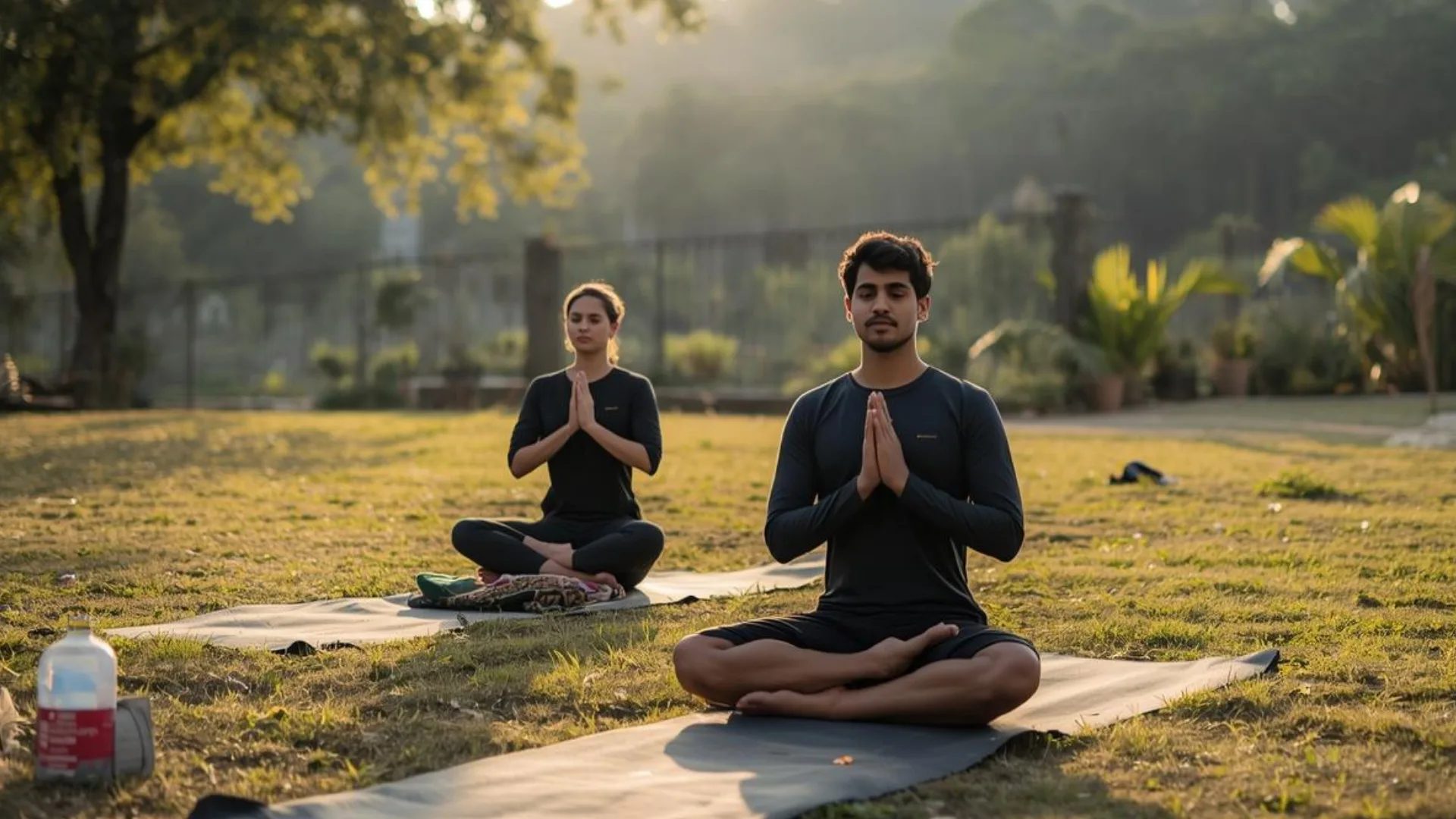
BREATH MEDITATION
In one hour, a normal person takes 900 breaths. The fewer the breaths, the stronger the body; the more the breaths, the weaker the body.
If there are 75 breaths per hour, it is said that the person has attained concentration (Dharana). If there are 6 breaths per hour, it is said that meditation (Dhyana) has been mastered. And if there is only 1 breath per hour, it is said that Sahaj Samadhi has been attained. In this way, Dharana, Dhyana, and Samadhi are all based on the BREATH, making breath meditation an important part of this journey. Life and death are also based on the breath. If a breath that leaves does not return, we are said to be dead.
SELF DISCOVERY
Although breath is the most valuable thing in our life, if we do not remain connected/aligned with it, we are merely like puppets of ignorance, controlled by ego, possessiveness, and attachment. Despite receiving a human body, we are not worthy of being called a human being.
To become a true human, one needs humanity. Ego must be destroyed, and humility must arise. Possessiveness must be destroyed, and broad-mindedness/vastness must arise. Attachment must be destroyed, and devotion must arise.
In this way, awareness filled with humility, devotion, and broad-mindedness should be awakened in our lives for every single BREATH. Only then can one truly be called a true human being. Thus, breathing with an awareness to meditate and support self-discovery, in order to get connected to your true self, will transform your relationship with not only yourself but the entire universe around you.
MIND BODY HEALING
Breathing with awareness will steady once mind in present state. Once the mind is steady it can be just be a spectator to what all is going around oneself. It will not involve itself in either good event or bad event but be a witness to it. Thus the effect of the circumstances will not disturb the mind and if mind is not disturbed it will take the most appropriate steps at the right moment. This will not only have a positive effect on once mind but also on once body, thus resulting to mind body healing.

BREATH AND MEDITATION TO SELF DISCOVERY
Swami Dayanand Tirth (Dasanudas) has explained in his book “Fulwadi” how BREATH became the medium to know the eternal soul residing in every human being.
“I am writing this here because I remembered an incident from my spiritual practice (sadhana): Once, a thought crossed my mind—’I worship the Mother Goddess, I chant on the rosary beads, yet why do I not see the direct physical form of the Mother Goddess?’ At that time, I was feeling extremely restless. The joy from performing worship, turning the rosary beads, and singing devotional hymns vanished completely, and I would start weeping. I would remain lying down in solitude, observing silence and fasting.
During that period, a saint came from the direction of the Himalayas (from Uttarkashi). Seeing me weep, he said, ‘Whether you are seeking the Mother Goddess or the Father God, as long as you seek Outside, weeping is written in your destiny. When will your turn to smile ever come? If you want to bring about a time to smile, then: Decide/define the form of the one you are seeking, Seek that form inside your own physical body (pinda), and Once found inside the body, look for that same form outside as well, because it is omnipresent.
After that, the joy you experience will have no anxiety or distress behind it , your weeping will stop, and your smiling will begin. Yet, do not stop there.
Forgetting both joy and anxiety—that itself is God-realization, supreme bliss (Paramananda), and infinite peace.’
After that, my practice of silence, fasting, and solitude naturally kept increasing. I began experiencing various inner realizations; the inner voice (Antarvani) began to spur, and by acting accordingly, the inner and outer worlds started feeling identical. I saw the form I had decided upon, and moreover, God out of grace showed me His indescribable True Form (Satya Swaroop).
The distinctions between Mother Goddess and Father God—that is, Shiva and Shakti—broke down; the distinctions among deities and divine incarnations broke down; gradually, the distinctions between humans broke down; and finally, even the distinctions between animalistic tendencies and demonic nature broke down. It became clearly understood that in every single action of everyone, it is only the one God who is playing.”
You might say, ‘All that happened is true, but you didn’t tell us what you actually did to attain all of it.’ Yes, listen. First, I decided that God is of the nature of divine light (Jyotiswaroop). Therefore, so that I could experience the vision of that divine light within myself, I took refuge in a room which, upon entering and closing its small window, would become pitch dark, with only a tiny light showing through the crack of the window. But I used to plug that too by stuffing cloth rags into it to close it completely.
Now, every morning I would lean a mirror against the wall and sit steadily with a focused mind five feet away.
WITH MY BREATH IN, I would enter into my physical body (pinda), and with each BREATH OUT, I would go out toward the mirror in front of me.
Apart from that, I had forgotten everything else.
One who has mastered breath has mastered thoughts, and one who has mastered thoughts has conquered the universe.
When my eyes were closed, meditation on the divine light (Jyotiswaroop) would happen automatically, and when my eyes were open, fixed gazing (tratak) on the mirror would happen automatically. Instead of the mirror being completely invisible initially due to the dense darkness in the room, now the mirror started becoming visible in faint light. My reflection inside it also began to appear.
There was a temple nearby. In the evening, when the sounds of bells, gongs, and aarti came, I would step outside from there. In the twelve-hour span from morning to evening, at noon I would sleep right where I sat. There was no fixed schedule for how long I sat or slept, nor was anything fixed like ‘time.’ Still, based on my behavior after coming out, I could conclude that the sitting time was longer than the sleeping time.
Generally during my fasts, I would drink thirty-six ounces of water, but when sitting in that room, I would observe three waterless fasts. After passing three days in this manner, I would pause the experiment for a week and then start it again. When breaking a fast observed on air , I would drink hot water, tea, coffee, etc. I would not drink cold water even by mistake. In this way, three experiments were conducted in a month. Every time, for about six months, more and more light was attained.
Once, it so happened that the room became filled with light, and that light was wrapped around my head in a large measure as well. I could see that in the mirror alongside my reflection. Furthermore, the light appeared somewhat yellowish. After that, I stopped that experiment. Thereafter, I began to see glimpses of that same yellow light around many straightforward, simple, and pure-natured (sattvic) people. At that time, people outside considered me crazy, but I remained absorbed in my own spiritual fervor (dhoon) and derived great joy from it. Whatever anyone said about me, even if they treated me with contempt, it felt natural to me. During that period, my bathing and washing had stopped; my clothes were dirty too. Therefore, it was natural for those who keep pure externally to feel an aversion towards me. Why should I take offense at that?” – SWAMI DAYANAND TIRTH (DASANUDAS) – BOOK – “FULWADI”
This is the Journey Within which we too can accomplish with the help of our BREATH and RESULTING MEDITATION, TRANSFORMING OUR RELATIONSHIP WITH OURSELVES AND HENCE THE ENTIRE HUMANKIND.
Key Takeaways
- Breath as the Bridge: The breath serves as the vital link between the physical body and the eternal soul. By consciously slowing and observing the breath through Dharana (concentration), Dhyana (meditation), and Samadhi (absorption), an individual gains mastery over the restless oscillations of the mind.
- The Alchemy of Character: True humanity is forged by dismantling ego, possessiveness, and attachment, replacing them with humility, broad-mindedness, and devotion. Meditation is ultimately shown to be as much an ethical and psychological transformation as it is a spiritual one.
- The Inward Shift: Seeking the Divine outside oneself often leads to restlessness. By first recognizing the divine form within the physical vessel (pinda) and subsequently seeing it omnipresently in the external world, the seeker transcends dualities, judgments, and illusions.
Ultimately, the text reminds us that the journey within requires immense patience, discipline, and surrender. By transforming our relationship with our own breath and mind, we profoundly transform our relationship with ourselves and, by extension, the entire world.
RAJIV NARENDRA THAKER