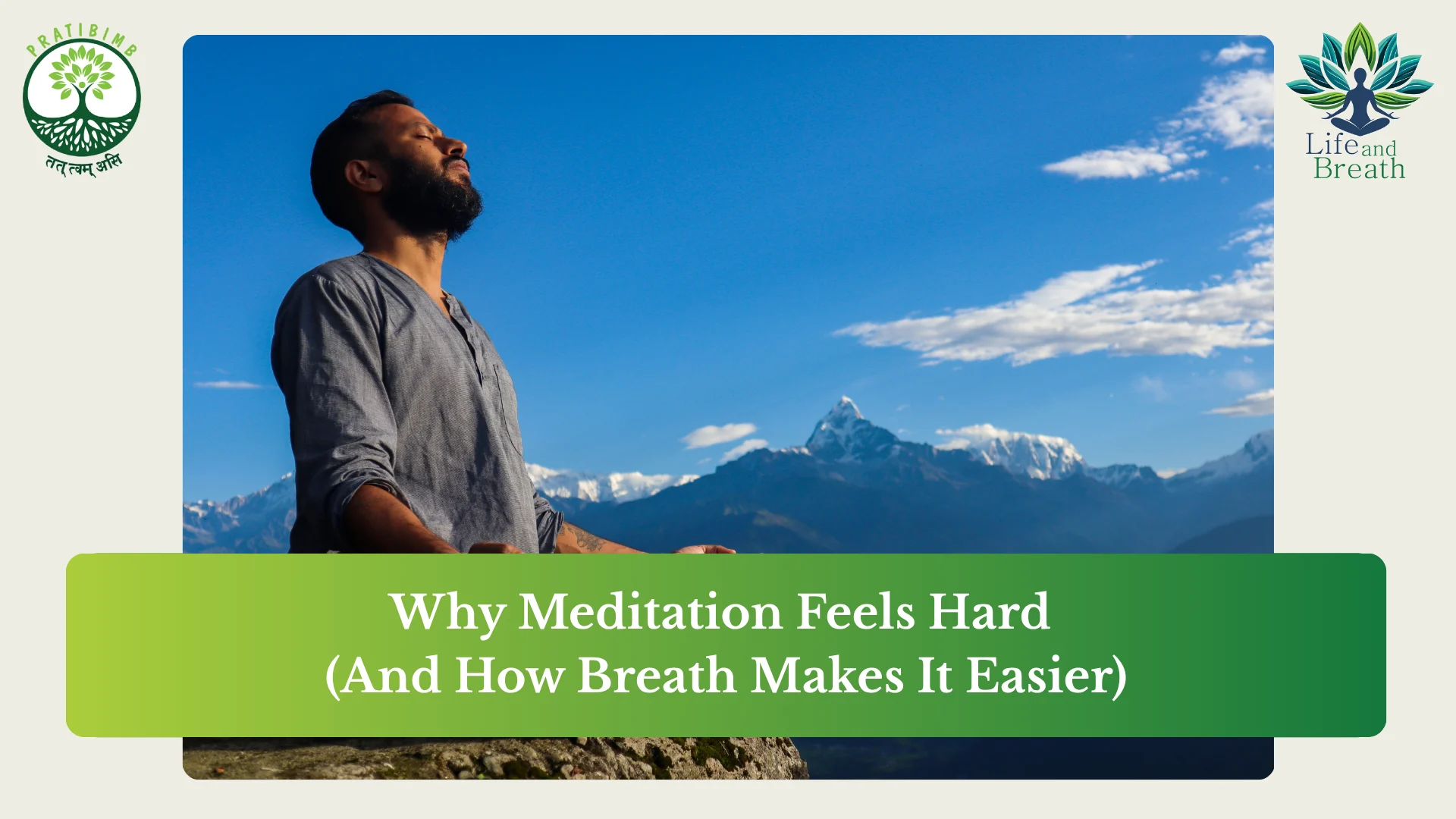
Why is meditation difficult for beginners?
Meditation is difficult for beginners because the human brain evolved for survival, not stillness. Naturally, the mind is designed to scan for threats, plan for the future, and remember the past. When you sit in silence, you become aware of this constant mental activity—often called the “monkey mind.” Beginners frequently mistake this awareness of noise for failure, when in reality, noticing the wandering mind is the first successful step of meditation.
The Biological Reality: Why the Mind Resists Stillness
Throughout history, meditation has survived the test of time across Yogic, Buddhist, Zen, and Sufi traditions. Today, modern neuroscience validates what ancient sages always knew: meditation is a powerful tool for stress reduction and mental clarity. However, knowing the benefits doesn’t make the first few minutes on the cushion any easier.
Survival vs. Silence
The human brain was never designed for stillness. Its natural tendency is movement:
- Predicting and Planning: Ensuring future safety.
- Worrying and Comparing: Assessing social and physical standing.
- Imagining: Creating scenarios to solve potential problems.
In our modern era, this evolutionary bias is intensified by technology. Constant notifications, deadlines, and digital stimulation train us to react instantly. When we suddenly ask the mind to “stop,” we aren’t just fighting a habit; we are fighting millions of years of biological conditioning.
How to Focus During Meditation Breathing
One of the most common questions is how to focus during meditation breathing when the mind is so loud. The “Life & Breath” approach suggests that focus is not about forced concentration, but about gentle redirection.
1. Stillness of the Body
You cannot have a calm mind without a still body. Before focusing on the breath, ensure your physical foundation is set. Whether in a chair or cross-legged, sit with an erect spine. Relax the body from the top of your head to the tips of your toes. Physical stillness sends a signal to the brain that there is no immediate threat, making focus possible.
2. Personalize Your Goal
As taught by Pravin Mankar Sir, personalizing each meditation with a specific goal can work wonders. Instead of meditating because you “should,” give your mind a purpose—whether that is finding clarity on a specific issue or simply building emotional resilience.
3. Use Rhythm to Stabilize
Rhythmic breathing is a powerful biological hack. When your breath has a steady, predictable flow, it stabilizes your attention. A smooth, gentle rhythm calms both the mind and the body surprisingly quickly, providing a “track” for your focus to stay on.
4 Easy Meditation Techniques Using Breath
If you find silent sitting impossible, these easy meditation techniques using breath provide the structure your mind needs to stay anchored.

1. Count the Breath
Counting gives the restless mind a job. It provides a simple structure that is easy for a beginner to follow:
- Inhale… Exhale (Count 1)
- Inhale… Exhale (Count 2)
- Continue until you reach 10, then restart. If you lose count, simply start back at 1 without judging yourself.
2. Label Your Thoughts
Instead of fighting thoughts, label them. When a thought arises, notice it, label it gently (“planning,” “remembering,” or “worrying”), and return to the breath. This creates a gap between you and your thoughts, teaching you that you are the observer, not the thinker.
3. Focus on Specific Sensations
To sharpen your awareness, pick one physical sensation of the breath to watch:
- The feeling of cool air entering the nostrils.
- The warmth of the air leaving the body.
- The expansion of the abdomen or the movement of the chest. By narrowing your focus to one physical detail, you give the “monkey mind” less room to wander.
4. The “Returning” Practice
The most important technique is the act of returning. Meditation is not the absence of wandering; it is the practice of returning. Every time you realize you have drifted and you bring your attention back to the breath, you have successfully completed one “rep” of mental training.
Common Misconceptions That Make Meditation Harder
“My mind must be empty.”
This is perhaps the biggest myth. The goal of meditation is not to stop thinking, but to stop being controlled by your thoughts. Success is not a blank mind; it is the moment you realize you were lost in thought and choose to return to your anchor.
“I’m not good at this.”
Meditation is a skill, not a talent. Much like going to the gym, the “struggle” is where the growth happens. If you find how to focus during meditation breathing difficult, it simply means your “mindfulness muscle” is getting a workout.
“Silence is loud.”
For many beginners, silence feels uncomfortable or even aggressive. This is because we are so used to distraction. Over time, meditation teaches us that silence is not emptiness; it is a space of awareness where we can finally see things as they are.
What Meditation Eventually Teaches Us
If you persist through the initial difficulty, meditation begins to change your internal landscape. You start to realize:
- Attention is a choice: You do not need to follow every thought.
- Emotions are temporary: They do not require an immediate reaction.
- Awareness is calming: Simply being present is enough to lower stress.
The mind may never become perfectly silent, but it can become less noisy, less reactive, and less compulsive. The real purpose of meditation is not to escape thought, but to learn not to be dominated by it.
Conclusion: The Practice of Returning
Meditation is a journey of a thousand returns. Each time you bring your attention back to your breath, you are reclaiming your peace from the chaos of modern life.
By understanding why meditation is difficult for beginners and using easy meditation techniques using breath, you can transform the practice from a chore into a sanctuary. Don’t aim for a perfectly quiet mind; aim for a mind that knows how to find its way home to the breath.
[Ready to make meditation easier? Join our ‘Life & Breath’ course to learn the specific rhythmic breathing and meditational techniques that make focus effortless.]